

20-Lane Wet Wipes Production Line Supports Both Pop-Up and Non-Pop-Up Wipes
When expanding production capacity, wet wipe manufacturers often face a range of challenges, including production efficiency, product specification changes and packaging consistency. The 20-channel pop-up wet wipe production line is an integrated, automated system designed specifically to address these core requirements. It enables continuous production of wet wipes—from folding, liquid application and cutting to packaging—and is suitable for a wide range of products, including baby wipes, household cleaning wipes and medical care wipes.
Multi-mode folding design to meet diverse market demands
This 20-channel wet wipe production line supports both pop-up and non-pop-up folding methods. For pop-up wet wipes, which are common in the retail market, it enables the continuous single-sheet dispensing of wipes; for certain industrial, medical or specialised packaging requirements, it can be rapidly switched to a non-pop-up configuration.
In terms of raw material compatibility, the equipment is compatible with a variety of substrates, including spunlace non-woven fabric, thermal-bonded non-woven fabric, bamboo fibre non-woven fabric and flushable non-woven fabric. Equipped with an automatic web guiding system and a tension control system, it ensures stable fabric conveyance during high-speed operation, minimising folding misalignment and dimensional errors, and enhancing the consistency of the finished product.
Precise liquid application and synchronised processing enhance product quality stability
One of the key factors in the quality of wet wipes lies in the uniformity of liquid application. This production line utilises a flowmeter-controlled liquid dispensing system; through multi-channel synchronised liquid supply, it achieves uniform wetting across 20 production channels, with liquid application accuracy controlled within a range of ±2 per cent.
During the manufacturing process, the equipment synchronises the control of operations such as liquid application, folding and cutting. After the non-woven fabric has been uniformly saturated, it enters the folding system directly, before being cut to a fixed length by high-speed rotating blades. The system can automatically set the quantity per pack according to product specifications. Common configurations support various pack sizes, ranging from 10, 20, 40 and 80 to 160 wipes, helping businesses meet a wider range of market demands.
Integrated Automated Production from Wipes to Packaging
Compared to single-machine production models, the greatest advantage of the 20-channel production line lies in the automatic integration of upstream and downstream processes. Once cut, the wet wipes proceed directly to the packaging system, where processes such as pillow-style packaging, perforation, labelling, sealing and the automatic application of plastic caps are carried out.
This continuous production method not only reduces the need for manual intervention but also minimises the risk of contamination associated with the transfer of semi-finished products. At the same time, the coordination of multiple processes enhances overall equipment utilisation, reduces downtime and waiting times, and provides more stable production assurance for large-scale wet wipe manufacturers.
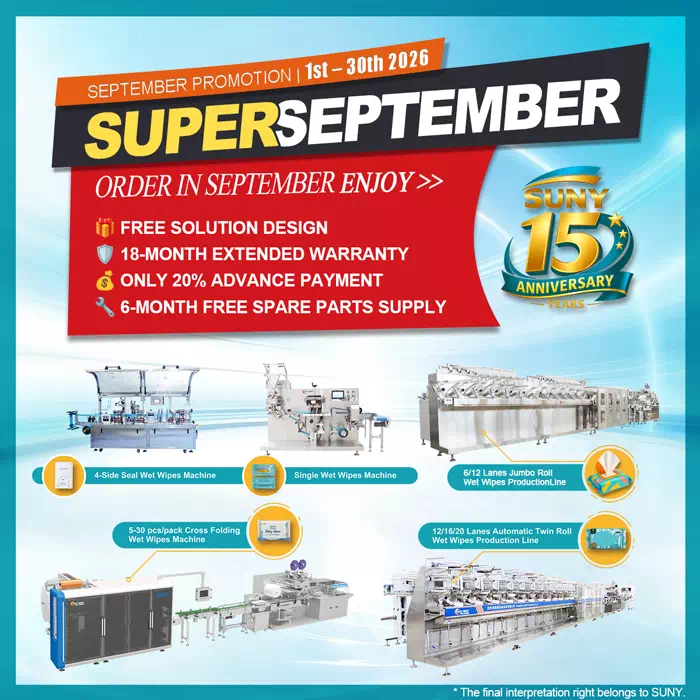 SUNY 15th Anniversary | Super September Promotion
CONTACT US
If you have any requirement or suggestion, please fill in the form and send to us, thanks! Email:sunymachine@gmail.com Whatsapp:+8613674945231